Making European learning achievements portable and verifiable.
As part of the EU.ACE initiative, SAPIO supported a cross-border pilot involving European universities to explore how academic achievements can move beyond traditional certificates.
Learners received digitally verifiable credentials representing their achievements, designed to be held directly by the recipient and independently verified when needed.
The pilot brought verifiable credentials into a real academic setting, providing practical insights into issuance, learner adoption and the requirements for making educational credentials portable across institutions and borders.
SAPIO provided the digital credential infrastructure for the EU.ACE pilot, enabling participating universities to issue learning achievements as verifiable digital credentials rather than relying exclusively on conventional documents or certificates.The implementation covered the complete credential lifecycle, from defining the information represented in the credential to issuance, reception by the learner and subsequent verification.
Turning academic information into structured credentials.
The first step was translating the learning achievement into a structured digital credential.
Instead of creating another digital representation of a paper certificate, the relevant information was represented as structured, machine-readable data. This means that information about the achievement, its recipient and the issuing institution becomes part of the credential itself and can later be processed and verified digitally.
This distinction is fundamental. A conventional PDF can display information about a qualification, but understanding and validating that information usually depends on a human reader, the issuing institution or an external verification system. A verifiable credential combines the information with cryptographic proof of its origin and integrity.
Issuing credentials directly to learners.
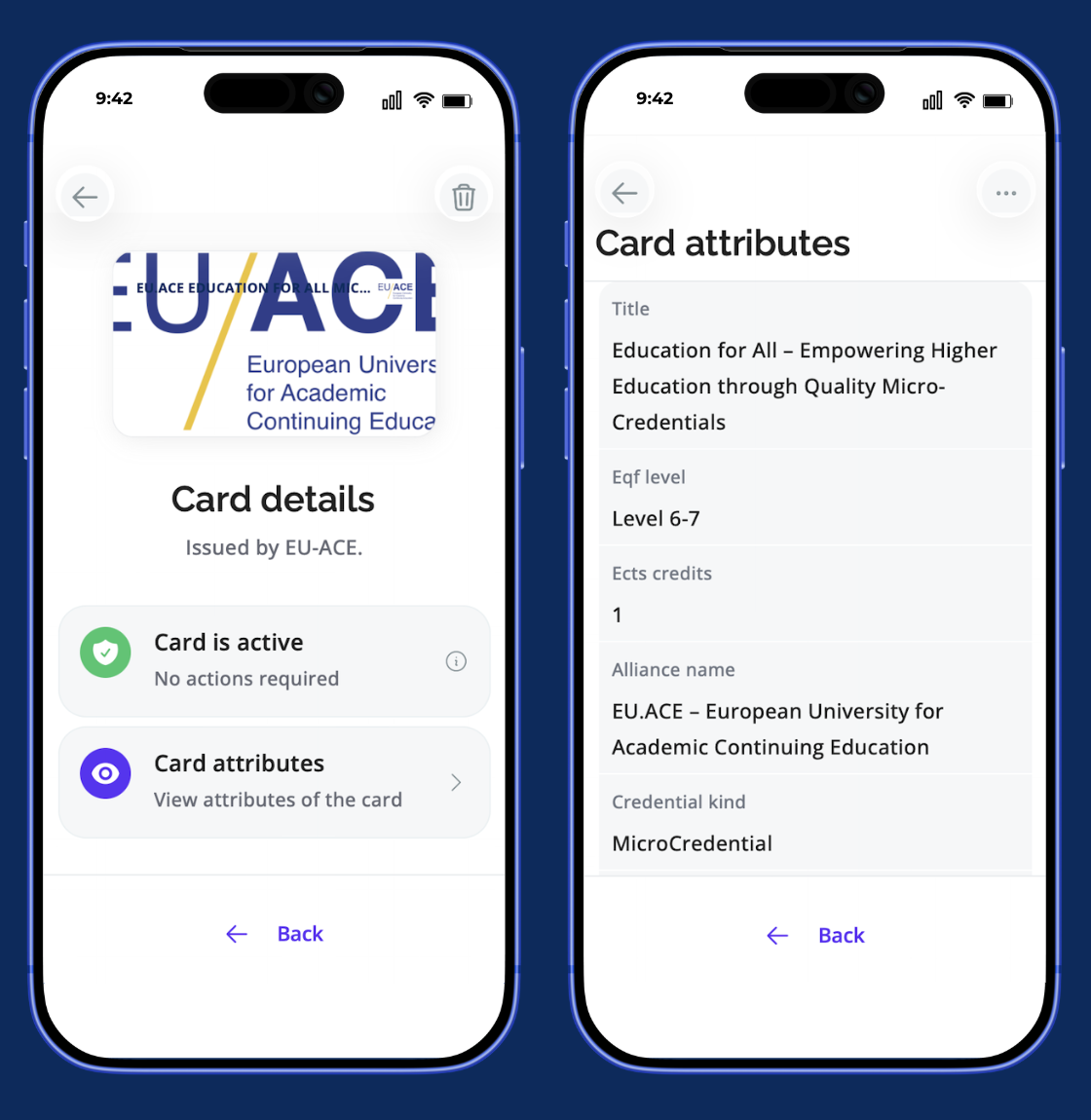
Once the credential structure had been defined, the participating institution could issue credentials to individual learners through SAPIO. Each learner received an invitation to retrieve their credential and store it in a compatible digital wallet. The credential therefore did not remain confined to the university’s systems or to SAPIO: it was transferred to the learner, who could retain it and use it beyond the original issuance process.
This learner-controlled model was an important part of the pilot. Academic achievements are created by institutions, but their value extends far beyond them. Graduates may need to demonstrate their qualifications to another university, an employer or another organisation, potentially years later and in another country.
Verification without returning to the issuer.
Once received, the credential could subsequently be presented by the learner for verification.Rather than asking the university to manually confirm whether a certificate was authentic, the credential contains the cryptographic information required to verify its integrity and provenance. A verifier can therefore determine whether the presented information corresponds to what was originally issued and whether it has been altered since issuance.This changes verification from a document-checking process into a digitally verifiable interaction.For universities, this opens the possibility of reducing manual verification processes while maintaining control over what they issue. For learners, it creates a portable proof of achievement that is not dependent on continued access to a university portal. For receiving organisations, it provides structured information whose origin and integrity can be technically verified.
Testing the complete credential journey.
The EU.ACE pilot allowed this process to be tested with actual learners and participating universities rather than as an isolated technical demonstration.The implementation covered the complete journey:
academic achievement → credential creation → institutional issuance → learner reception →
wallet storage → presentation → independent verification
This provided practical insights that go beyond whether a credential can technically be generated.The pilot allowed SAPIO and the participating institutions to observe how learners interact with a new form of digital credential, how the transition from institutional systems to learner-controlled wallets works in practice, and where usability and communication become as important as the underlying technology.
Building towards interoperable European credentials.
The broader objective extends beyond digitising certificates. European education is inherently cross-institutional and increasingly cross-border. Yet the information contained in qualifications often remains difficult to exchange, interpret and verify between different organisations and systems.
The EU.ACE implementation demonstrated how educational achievements can instead become structured, portable and cryptographically verifiable digital objects while preserving the authority of the institution that issued them.For SAPIO, the pilot therefore represented more than the issuance of a set of digital credentials. It was an opportunity to validate the infrastructure and operational processes required to connect educational institutions, learners and future verifiers through trusted digital credentials.
The result is a model in which institutions remain the authoritative source of an achievement, learners gain greater control over how they carry and present it, and third parties can verify the information digitally when it is presented to them.
Verifiable credentials issued in a real European higher-education setting.
Credential reception / claim rate by participating learners.
Cross-border implementation involving major universities among EU and CH.
Everything you need to know.

Self-Sovereign Identity (SSI) is a decentralised approach to digital identity management, allowing individuals to own, control, and share their personal data securely without relying on intermediaries. It ensures privacy, security, and compliance through blockchain technology.
We use SSI because it provides a portable, immutable, and easily verifiable digital identity solution. Unlike traditional systems tied to centralised databases, SSI allows users to securely carry their credentials. It ensures data integrity with blockchain and enables instant verification without intermediaries.
Our platform is built on open, internationally recognised standards, including OpenID for Verifiable Credentials (OpenID4VC). Cryptographic signatures, trusted certificates, and clear governance ensure credentials are verifiable, privacy-preserving, and future-proof, fully aligned with European (eIDAS 2.0, EUDI) and Swiss digital identity frameworks.
SAPIO is designed with HR teams in mind, offering a user-friendly interface that simplifies credential management. No technical expertise is required: issue, verify, and manage employee credentials in just a few clicks. The streamlined process saves time, reduces errors, and enhances trust, allowing HR professionals to focus on what matters most: building great teams.
Yes. With SAPIO, credentials are fully portable and easily shareable. They can be securely exchanged between parties, such as employers and institutions, using universally accepted standards, ensuring seamless verification and compatibility across different systems and platforms.